
In short: the essential things to visit in Marrakech are Jemaa el-Fna square, the souks of the Medina, the Koutoubia Mosque (from outside), Ben Youssef Madrasa, Bahia Palace, the Saadian Tombs, El Badi Palace and Jardin Majorelle with the Yves Saint Laurent Museum. Add one experience outside the walls — a sunrise balloon flight, the Agafay Desert or the Ourika Valley in the Atlas Mountains — and you have seen what makes the city special. Three full days is the sweet spot.
Marrakech rewards travellers who plan a little. Its best sights sit close together inside the old Medina, but the lanes are confusing, opening hours vary and the midday heat changes how much you can do. This guide groups the places to see in Marrakech by area, tells you when to go, how long each one takes, and how to fit them into a realistic itinerary.
Marrakech attractions at a glance
The table below lists the main Marrakech tourist attractions, where they are and how much time to allow. Use it to sort your must-sees from your maybes.
| Place | Type | Area | Time needed | Best moment |
|---|---|---|---|---|
| Jemaa el-Fna | Main square, street life | Medina | 1–2 h | Late afternoon to evening |
| Souks of the Medina | Markets, crafts | Medina (north of the square) | 2–3 h | Morning, before the crowds |
| Koutoubia Mosque | Landmark (exterior only for non-Muslims) | Medina edge | 20–30 min | Sunset |
| Ben Youssef Madrasa | Historic Quranic school | Northern Medina | 45 min–1 h | Opening time |
| Bahia Palace | 19th-century palace | Southern Medina | 1 h | Opening time |
| Saadian Tombs | 16th-century royal necropolis | Kasbah | 30–45 min | Morning |
| El Badi Palace | Palace ruins, rampart views | Kasbah | 1 h | Morning or late afternoon |
| Le Jardin Secret | Restored riad garden | Medina | 45 min | Midday break |
| The Mellah | Historic Jewish quarter | Southern Medina | 1 h | Morning |
| Dar El Bacha | Palace-museum, coffee house | Medina | 1 h | Late morning |
| Jardin Majorelle | Botanical garden | Gueliz / Majorelle | 1 h | 8:00 opening |
| Musée Yves Saint Laurent | Fashion museum | Next to Majorelle | 1 h | Any day except Wednesday |
| Menara Gardens | Olive grove and basin | West of the Medina | 45 min | Late afternoon |
| Sunrise balloon flight | Aerial experience | Plain outside Marrakech | Half morning | Dawn |
| Agafay Desert | Stony desert, camps | South-west of the city | Half day to overnight | Sunset |
| Ourika Valley | Atlas valley, waterfalls | High Atlas | Full day | Spring to autumn |
Inside the Medina: the historic heart of Marrakech
The Medina is the walled old city founded by the Almoravids in 1070–1072. It has been a UNESCO World Heritage Site since 1985, and most of the best places to visit in Marrakech sit within a 20-minute walk of each other here. Wear comfortable shoes and download an offline map before you go in: lanes change names, and GPS is unreliable between high walls.
1. Jemaa el-Fna square

What it is: the main square of Marrakech and the meeting point of the whole Medina. UNESCO recognises the cultural space of Jemaa el-Fna as part of the world’s intangible heritage, thanks to its storytellers, musicians and performers.
The square changes completely through the day. In the morning it is open and quiet, with orange-juice stalls and a few henna artists. From late afternoon, food stalls are set up, smoke rises from the grills and the crowd thickens. For the best view, take a drink on one of the rooftop cafés around the edge just before sunset.
- Tip: photographing performers or animal handlers is usually expected to be paid for. Agree before you lift your phone, or keep it down.
- Tip: carry small change in dirhams for juice, snacks and tips.
2. The souks

North of Jemaa el-Fna, the souks spread out in a maze of covered alleys, each traditionally dedicated to one craft: leather, metalwork, lanterns, wool, spices. Souk Semmarine is the main artery; follow it and you will reach smaller squares like Rahba Kedima, known for spices and woven baskets, and the dyers’ area where skeins of wool hang to dry.
Bargaining is normal for crafts. Start lower than you plan to pay, stay friendly, and walk away politely if the price does not suit you. If you would rather understand what you are looking at — and not get lost — a local guide for half a day is money well spent; this private guided walk through the Medina covers the souks and the main monuments.
3. Koutoubia Mosque

The Koutoubia is the city’s landmark: its 12th-century Almohad minaret is visible from almost everywhere and served as a model for later minarets in Seville and Rabat. The mosque is open to Muslims only for prayer, but the exterior and the gardens beside it are free to visit. Come at sunset, when the stone turns pink and the call to prayer rises over the square.
4. Ben Youssef Madrasa

This former Quranic school is one of the finest buildings in Morocco. The central courtyard combines carved cedar, stucco and zellige tilework around a rectangular pool, and the upper floor still shows the small rooms where students lived. Arrive at opening time to see the courtyard without a crowd. Nearby, the Marrakech Museum and the Almoravid Koubba make an easy add-on.
5. Bahia Palace

Built in the late 19th century for the grand viziers of the sultan, the Bahia Palace is a sequence of courtyards, gardens and reception rooms decorated with painted ceilings and zellige. It is one of the most visited Marrakech attractions, so go early. Allow about an hour, and do not skip the large marble courtyard at the end.
6. Saadian Tombs
The necropolis of the Saadian dynasty dates from the late 16th century, under Sultan Ahmad al-Mansur. Walled off for centuries, it was rediscovered in 1917. The highlight is the Hall of the Twelve Columns, with Italian marble and gilded muqarnas. The viewing spots are small, so a queue forms quickly; mornings are best.
7. El Badi Palace
Ahmad al-Mansur also built El Badi, once one of the most lavish palaces of its time. Today it is a vast ruin — sunken orange gardens, a huge central pool and thick pisé walls topped with stork nests. Climb to the terrace for one of the best views of the Medina rooftops with the Atlas Mountains behind.
8. Le Jardin Secret
Hidden behind a door in the Mouassine area, Le Jardin Secret is a restored historic garden with an Islamic garden, an exotic garden and a tower you can climb. It is the ideal midday pause: shade, running water and a quiet café, a few minutes from the souks.
9. The Mellah
The historic Jewish quarter lies next to the Bahia Palace. Walk through its spice market, visit the Lazama Synagogue and the Miaara Jewish Cemetery, one of the largest in Morocco. The Mellah gives a more residential, less polished view of the Medina — and a reminder of how many communities shaped Marrakech.
10. Dar El Bacha and the small museums
Dar El Bacha, the former residence of the Pasha of Marrakech, now houses the Musée des Confluences, with rooms around a beautiful courtyard. Its coffee house is popular, so expect a wait. Two more small museums are worth a stop if you have time: the Maison de la Photographie, with early photographs of Morocco and a rooftop café, and Dar Si Said, dedicated to carpets and weaving.
Gardens and museums outside the walls
11. Jardin Majorelle and the Berber Arts Museum

What it is: a botanical garden created by the French painter Jacques Majorelle and later restored by Yves Saint Laurent and Pierre Bergé, famous for its cobalt-blue villa, cacti and bamboo. The former studio houses the Pierre Bergé Museum of Berber Arts, one of the best introductions to Amazigh culture in the country.
- Hours (official site, checked November 2026): garden open every day, 8:00 a.m. to 5:30 p.m., last entry 5:00 p.m.; Berber Arts Museum 8:30 a.m. to 5:00 p.m.
- Tickets: buy only on the official Jardin Majorelle website. The garden warns that tickets from unauthorised sites are not valid.
- Tip: book the first slot of the day. By late morning the paths get crowded.
12. Musée Yves Saint Laurent Marrakech
A few steps from the garden, the Musée Yves Saint Laurent presents the designer’s work and his lifelong link with Marrakech. The building itself, in terracotta brick, is worth seeing. It is closed on Wednesdays and open 10:00 a.m. to 6:00 p.m. the rest of the week (last entry 5:30 p.m., per the official site). A combined ticket with the garden is available.
13. Menara Gardens
A large olive grove around a historic water basin with a green-roofed pavilion. It is less about flowers than about space and light: on a clear day, the Atlas peaks appear behind the pavilion, which makes it a classic photo. Go in the late afternoon.
14. Gueliz and Hivernage
The “new town” built during the French Protectorate is where you find art galleries, concept stores, modern cafés and restaurants. It is a good contrast to the Medina and the easiest area for an evening out if you prefer wider streets.
Experiences that go beyond sightseeing
Monuments explain Marrakech’s history. These experiences explain its setting: a city on a wide plain, between palm groves, desert and the High Atlas.
15. A sunrise hot air balloon flight

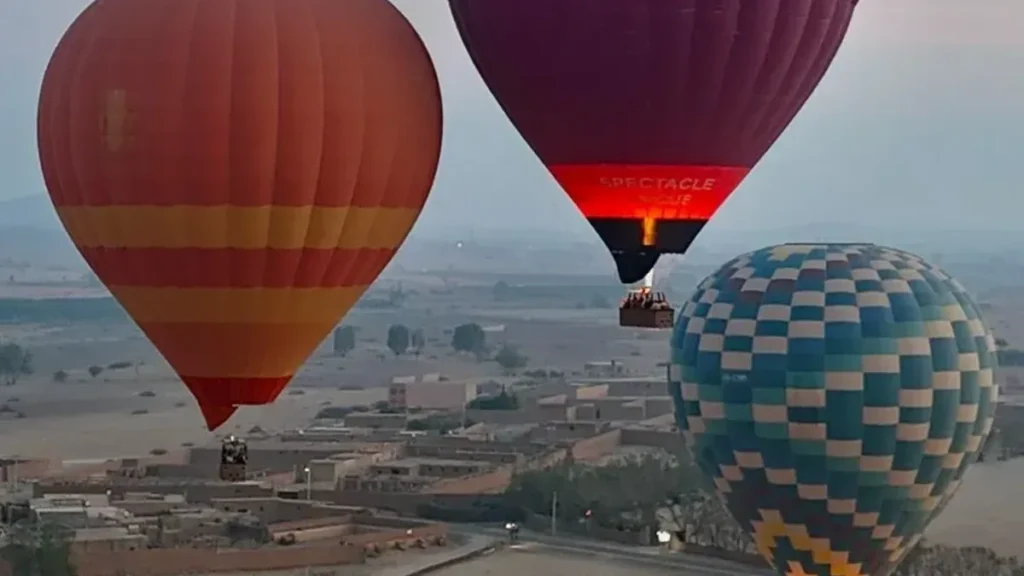
From the ground, Marrakech is all lanes and walls. From a balloon basket at dawn, you see how the city sits on its plain, with Berber villages, fields and the snow-capped Atlas on the horizon. It is one of the few things to do in Marrakech that does not cost you a day of sightseeing: hotel pickup is between 5:00 and 5:30 a.m., the flight lasts 40 to 60 minutes depending on the wind, and you are back at your riad by mid-morning.
See Marrakech from the sky at first light
Shared Sunrise Balloon Flight from €79 per person, or a private balloon for your group only (€3,600, up to 18 guests). Hotel pickup, tea before take-off, breakfast and flight certificate included. 25% deposit online, remaining 75% payable on the day of the flight.
Book it early in your stay: if the weather cancels the flight, there is still time to reschedule. Our complete hot air balloon guide explains how the morning unfolds, and the best season to fly covers temperatures and light through the year. Travelling as a family? Read flying with children first (minimum age 10).
16. The Agafay Desert

Agafay is a stony desert of rolling hills south-west of Marrakech — not the Sahara’s sand dunes, but close enough for a sunset, a camel ride or a night under the stars without a long road trip. Most visitors come for an afternoon and dinner at a desert camp. If you want more adrenaline, a half-day buggy ride in Agafay covers the tracks and viewpoints.
17. The Palmeraie
North of the city, the palm grove is home to luxury hotels, villas and wide sandy tracks. It is the classic spot for a camel ride or a quad bike tour through the palm groves, usually in the late afternoon when the light softens.
18. A hammam
The steam bath is part of daily life in Morocco. A traditional neighbourhood hammam is simple and inexpensive; a spa hammam in a riad or hotel adds massage and comfort. Either way, it is the perfect way to end a day of walking.
19. A cooking class
Many riads and cooking schools offer half-day classes that start at the market and end with your own tagine. It is one of the best things to do in Marrakech if you want to bring something lasting home.
Best day trips from Marrakech
Marrakech is a good base for the High Atlas, the desert edge and the Atlantic coast. Driving times below are approximate and depend on traffic and road works.
| Day trip | Why go | Approx. drive each way | Best for |
|---|---|---|---|
| Ourika Valley | Atlas villages, river, Setti Fatma waterfalls | About 1 h–1 h 30 | Easy nature day, families |
| Imlil and Toubkal National Park | Mountain hiking, Berber villages | About 1 h 30 | Walkers |
| Ouzoud Waterfalls | Tall waterfalls, olive groves | About 3 h | Photographers |
| Aït Benhaddou | UNESCO-listed ksar, Tizi n’Tichka pass | About 4 h | History and film lovers |
| Essaouira | UNESCO-listed coastal medina, port | About 2 h 30–3 h | Sea air, seafood |
20. Ourika Valley
The closest green escape from the city. The road follows the Ourika river into the High Atlas, ending at the village of Setti Fatma, where a guided walk climbs to a series of waterfalls. The hike is of moderate difficulty and takes about two hours. If you want everything organised — pickup at your accommodation, a French- or English-speaking guide and the walk to two waterfalls — see this Ourika Valley day trip from Marrakech, in a group or private.
21. Aït Benhaddou
The fortified village of Aït Benhaddou, on the old caravan route, is a UNESCO World Heritage Site and a favourite film location. The drive crosses the High Atlas over the Tizi n’Tichka pass, so it is a long but spectacular day. A private day trip to Aït Benhaddou lets you stop where you want on the pass.
22. Essaouira
A walled port town on the Atlantic, with a calmer pace, fresh fish and constant wind. Its medina is also on the UNESCO list. Ideal if you need a break from the heat of Marrakech.
Planning a multi-day trip to the Sahara instead? The desert dunes of Merzouga or Zagora need at least two days from Marrakech — see these private desert tours from Marrakech.
How many days do you need in Marrakech?
Short answer: three full days lets you see the main things to visit in Marrakech at a comfortable pace and add one experience outside the city. Two days covers the essentials of the Medina and Majorelle. With four or five days, add a day trip to the Atlas Mountains or Essaouira.
| Stay | Morning | Afternoon | Evening |
|---|---|---|---|
| Day 1 | Ben Youssef Madrasa, souks | Le Jardin Secret, Dar El Bacha | Jemaa el-Fna, Koutoubia at sunset |
| Day 2 | Jardin Majorelle at 8:00, YSL Museum (not Wednesday) | Bahia Palace, Mellah, Saadian Tombs, El Badi | Rooftop dinner in the Medina |
| Day 3 | Sunrise balloon flight | Rest, hammam or Menara Gardens | Agafay Desert sunset and dinner |
| Day 4+ | Ourika Valley, Imlil, Aït Benhaddou or Essaouira | ||
Only have one day? Start at Ben Youssef Madrasa when it opens, walk south through the souks to Jemaa el-Fna, see the Bahia Palace and the Saadian Tombs after lunch, and finish at the Koutoubia and the square at sunset.
Practical tips before you visit Marrakech
- Best time to visit: spring (March to May) and autumn (September to November) are the most comfortable, according to the Moroccan National Tourist Office. Summer afternoons are very hot; plan sightseeing early and late.
- Start early: the big monuments are quieter at opening time, and the light is better.
- Check hours on the day: opening times and entrance fees change, especially during Ramadan and public holidays.
- Dress: light clothing that covers shoulders and knees is the most comfortable way to blend in, especially in the Medina.
- Unofficial guides: people may offer to show you the way or tell you a road is “closed”. A polite “no, thank you” is enough.
- Money: carry dirhams in small notes for markets, taxis and tips; cards are accepted in many hotels and restaurants, less so in the souks.
- Getting around: the Medina is best on foot. For longer distances, use a petit taxi and agree on the meter or the fare before you get in.
- Travelling as a group? For a hen party or a celebration with friends, Marrakech EVJF organises group activities and packages (site in French).
Is Marrakech worth visiting?
Yes. Few cities combine so much within such a short distance: a UNESCO-listed medina full of living crafts, palaces and gardens, a modern district, a desert less than an hour away and the High Atlas on the horizon. The key is pacing. Mix one or two monuments a day with slower moments — a garden, a hammam, a rooftop — and keep one morning for the view from above.
If you want the image of Marrakech that stays with you longest, start one of your days before sunrise. Reserve your balloon flight or ask us on WhatsApp about availability for your dates.
Frequently asked questions
What are the best things to visit in Marrakech?
The must-see places in Marrakech are Jemaa el-Fna square, the souks, the Koutoubia Mosque, Ben Youssef Madrasa, Bahia Palace, the Saadian Tombs, El Badi Palace and Jardin Majorelle with the Yves Saint Laurent Museum. For an experience outside the city, add a sunrise balloon flight, the Agafay Desert or the Ourika Valley.
What should I not miss in Marrakech?
Do not miss Jemaa el-Fna at sunset, when the food stalls open and the square fills with music and storytellers. Inside, Ben Youssef Madrasa and the Bahia Palace show Moroccan craftsmanship at its best. Outside the Medina, Jardin Majorelle is the city’s most famous garden.
How many days do you need to visit Marrakech?
Three full days is ideal: two days for the Medina, palaces and gardens, and one for an experience outside the city such as a balloon flight or the Agafay Desert. Add one or two days for a day trip to the Atlas Mountains or Essaouira.
What are the best day trips from Marrakech?
The most popular day trips from Marrakech are the Ourika Valley and its waterfalls, Imlil in Toubkal National Park, the Ouzoud Waterfalls, the UNESCO-listed ksar of Aït Benhaddou and the coastal town of Essaouira. The Agafay Desert is close enough for a half day.
What is Marrakech most famous for?
Marrakech is famous for its UNESCO-listed Medina, the Jemaa el-Fna square, its souks, the Koutoubia Mosque, palaces such as Bahia and El Badi, and Jardin Majorelle. It is also known as the “Red City” because of the ochre colour of its walls and buildings.
Is Marrakech worth visiting?
Yes. Marrakech offers historic monuments, gardens, markets, food and easy access to the desert and the Atlas Mountains in one destination. Most travellers find three days enough to see the highlights without rushing.
Can non-Muslims visit the Koutoubia Mosque?
No. Non-Muslims cannot enter the Koutoubia Mosque, but they can admire the minaret and walk in the gardens around it at any time.
Do I need to book Jardin Majorelle tickets in advance?
Booking ahead is strongly recommended, especially in high season. The garden states that tickets are sold only on its official website (tickets.jardinmajorelle.com), and tickets bought elsewhere are not valid.